Parent updates, shared questions, learning flows, and staff handoffs.
Back to work
Health communication support concept
NICU4U
A health-communication support concept for helping NICU families and care teams maintain shared context under stress.
At a glance
NICU4U turns fragmented, high-stress information into a communication-support model for parents and care teams.
Journey mapping, service framing, content hierarchy, and prototypes.
Grounded in NICU stay records, feeding logs, and care questions.
Clarifies what changed, what matters, what to ask, and who can help.
Personas, support flows, information architecture, and screens.
Problem
NICU families and care teams need shared, actionable context when critical information is fragmented across people, shifts, and high-stress moments.
Why this matters
Families need a way to hold and share the questions that become difficult to track during prolonged, uncertain care.
- Is she growing appropriately for her gestational age?
- Are we producing enough milk?
- What changed this week?
- What should we ask during rounds?
- Who is responsible for this part of her care?
- How do we keep family informed without repeating the same emotionally draining conversation?
The problem is not a lack of information. It is processing, organizing, remembering, and communicating critical information under prolonged stress.
The NICU is a rotating system of doctors, nurses, specialists, and family members handing information across shifts while the family tries to keep up.
Design challengeHow might a NICU support system reduce communication strain without pretending uncertainty can be removed?
Primary evidence
NICU4U is grounded in longitudinal records from inside the problem.
The concept grew from a 100-day NICU stay, 578 feeding logs, growth tracking, pumping-output records, question lists, communication notes, and forecast models built to make uncertainty easier to reason about.
100 daysLongitudinal care period
578Feeding logs
10 sheetsTracking artifacts
3 modelsGrowth forecasts
Who this is for
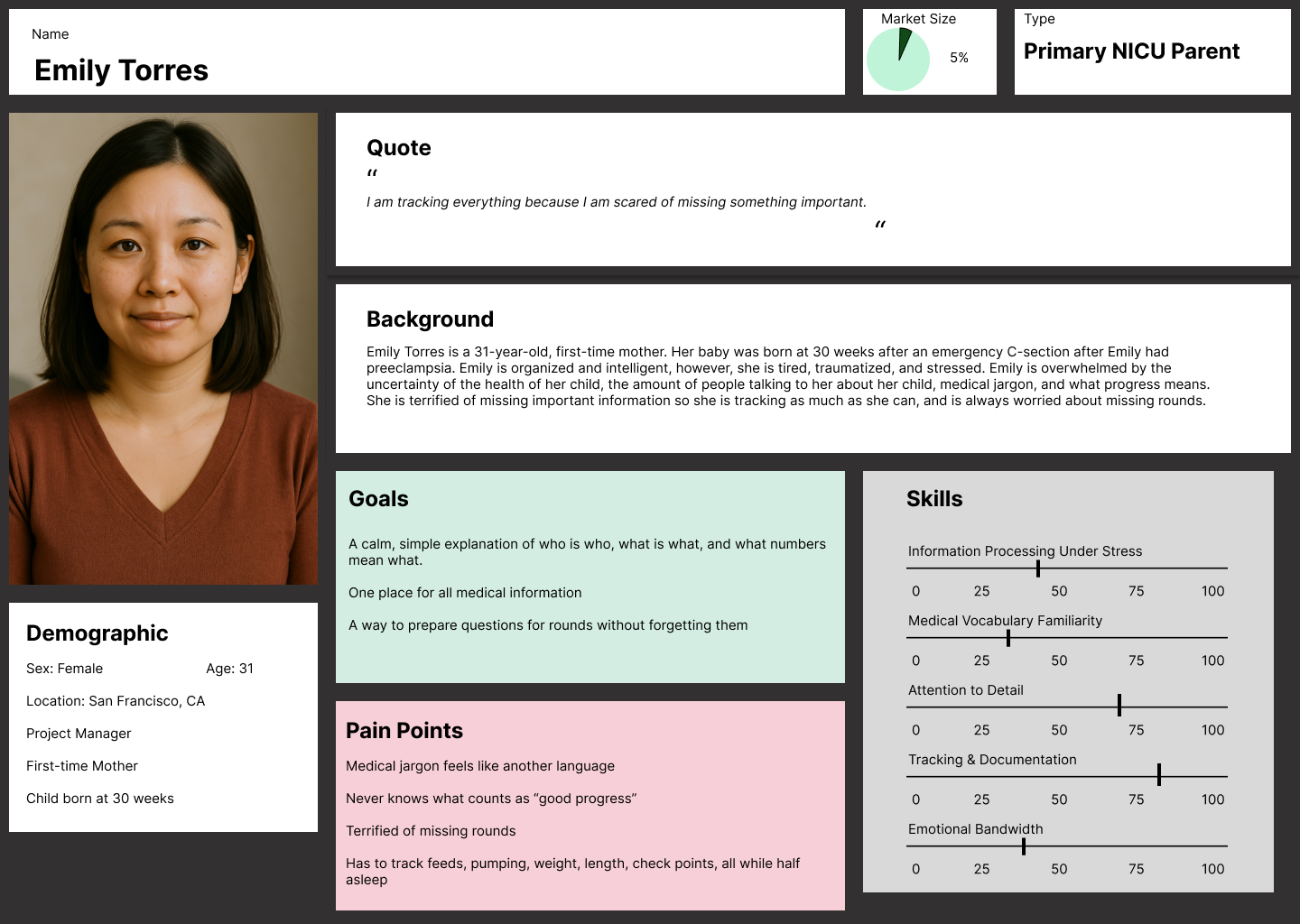
The Torres family models a communication system, not three isolated users.
Handoff flow
Rounds
Emily
James
Nadia repetition loop
The Torres family models a communication system rather than three isolated users. Emily manages daily information, James needs continuity across gaps, and Nadia fields questions across shifts. Mapping their handoffs made repeated explanations, missing context, and clinical boundaries visible as service-design problems.
Emily TorresJames TorresNadia Hassan, RN
Real artifact restoration
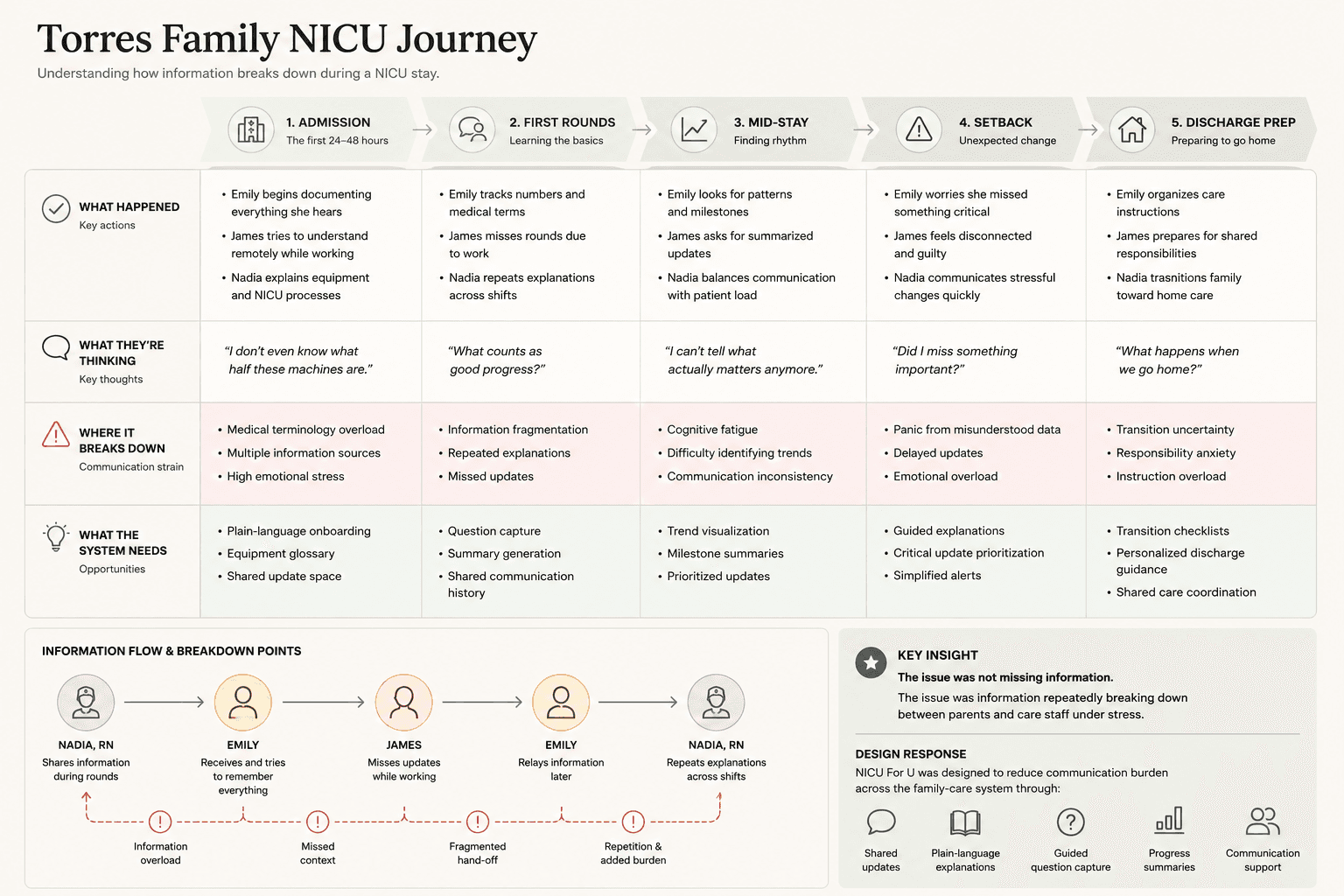
The Torres journey map models communication breakdown across the family-care system.
Design constraints under stress
Progressive disclosure, calm notification tone, no false reassurance, emotional readability, and clear escalation back to the care team.
Feature map
Daily summaries, term explanations, milestone tracking, guided questions, shared updates, and discharge preparation support.
Problem context
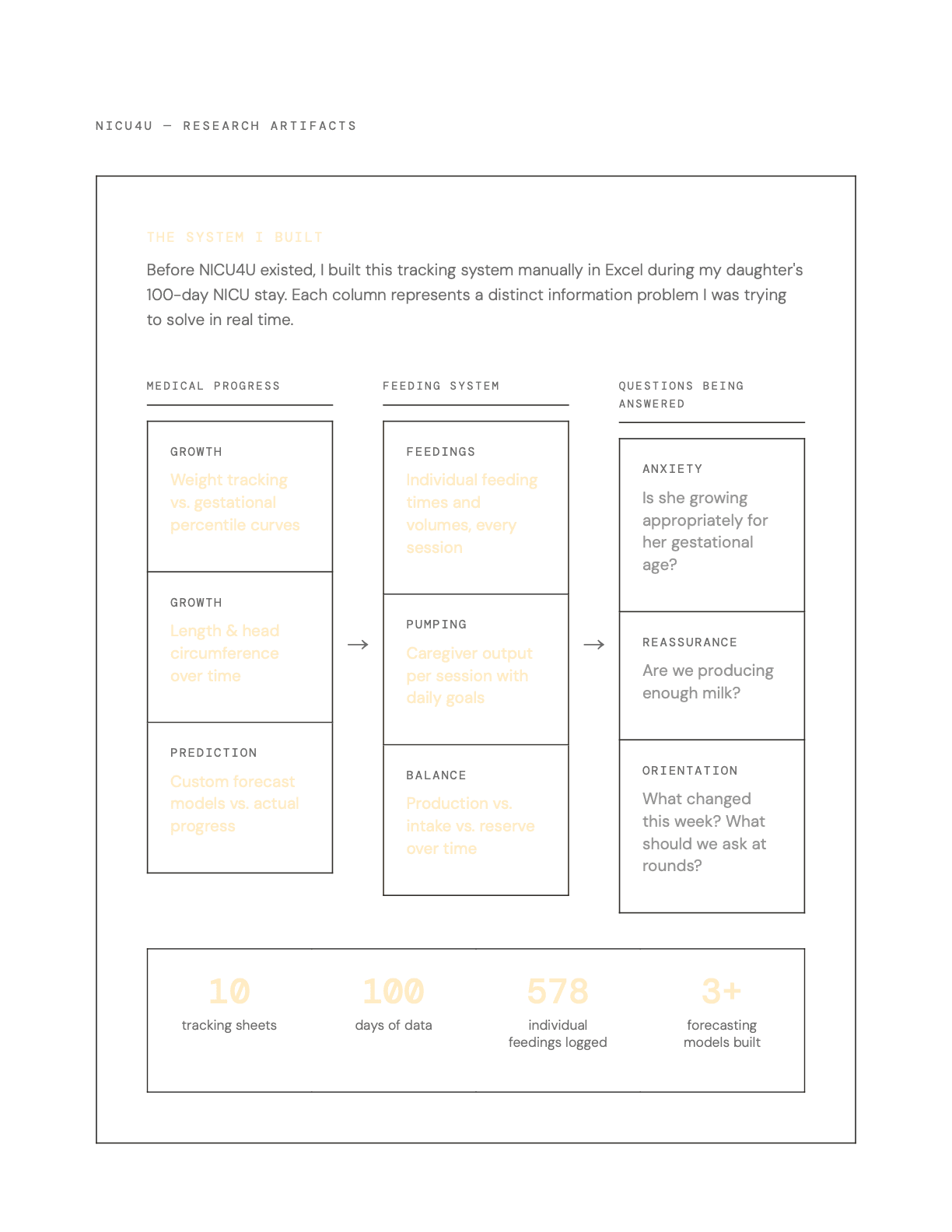
The first system was not an app. It was a way to organize fragmented information.
Records were organized across feeding times, volumes, daily totals, weight measurements, growth projections, and questions that needed to travel into care conversations.
Tracking intake alongside pumping output made patterns more legible than vague reassurance alone. That operational record became the evidence base for NICU4U's communication and orientation model.
System model
How the system moves
01
Orient
Explain where the baby is in the care journey and what changed recently.
02
Translate
Make updates, terms, and next steps understandable without oversimplifying care.
03
Coordinate
Help Emily, James, and Nadia keep questions and updates from fragmenting.
04
Escalate
Clarify what can be answered in-app and what belongs with the care team.
Design evolution
Evidence and care-team needs shaped a communication support system.
Fragmented care context
Longitudinal tracking records exposed where updates, questions, and progress information failed to travel between people.
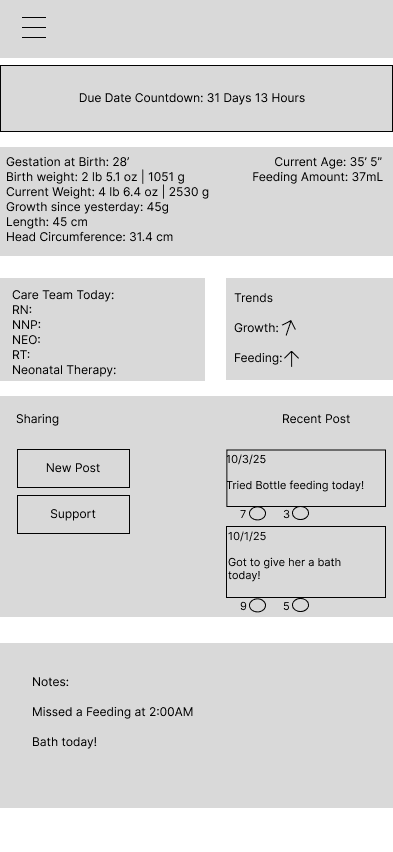
Low-fi parent home
Early wireframes grouped the information parents need to orient, record questions, and share approved updates.
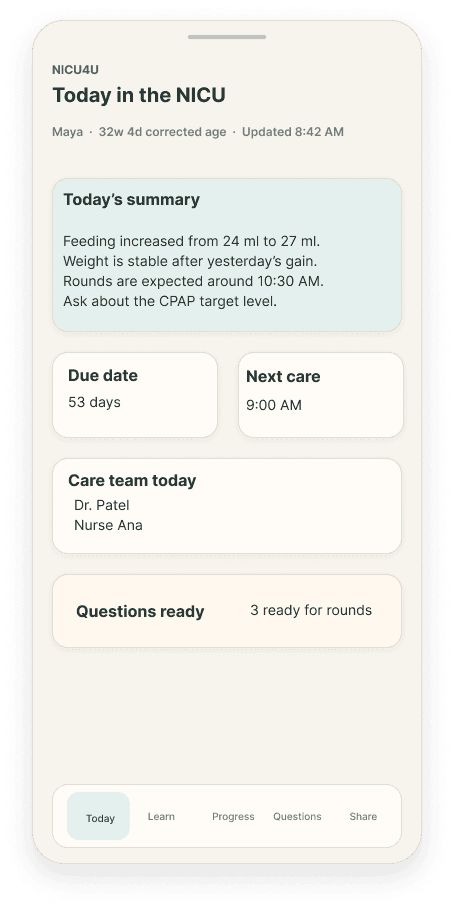
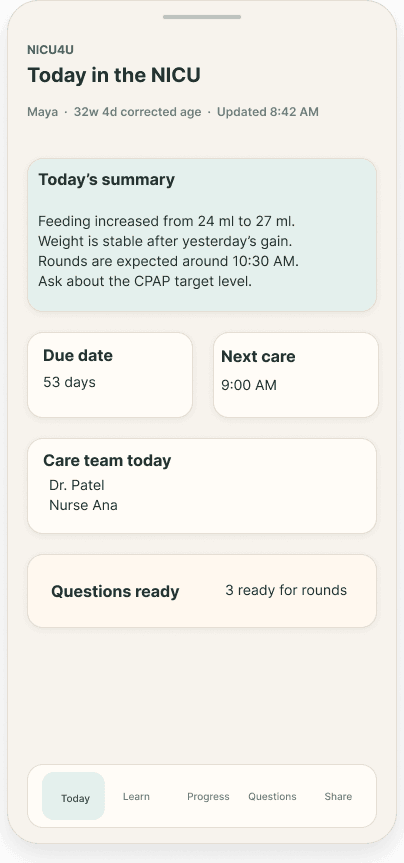
Today dashboard
The hi-fi direction translated those priorities into a calmer parent-facing view of status, updates, and next steps.
Tracking artifacts
Longitudinal records made the communication gaps concrete.
Ten tracking sheets, one hundred days of data, five hundred and seventy-eight individual feedings, and three forecast models documented the information parents need to carry across care conversations. Those records became evidence for a support system focused on clarity, question retention, and shared context.
Hi-fi prototype direction
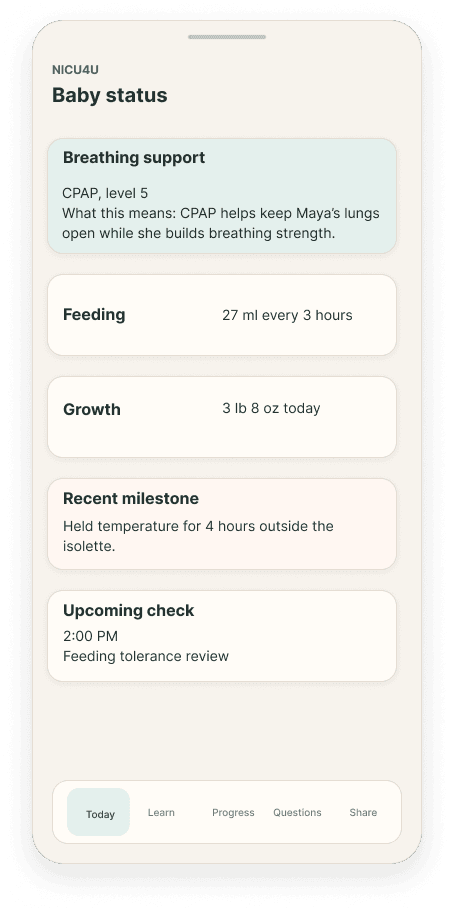
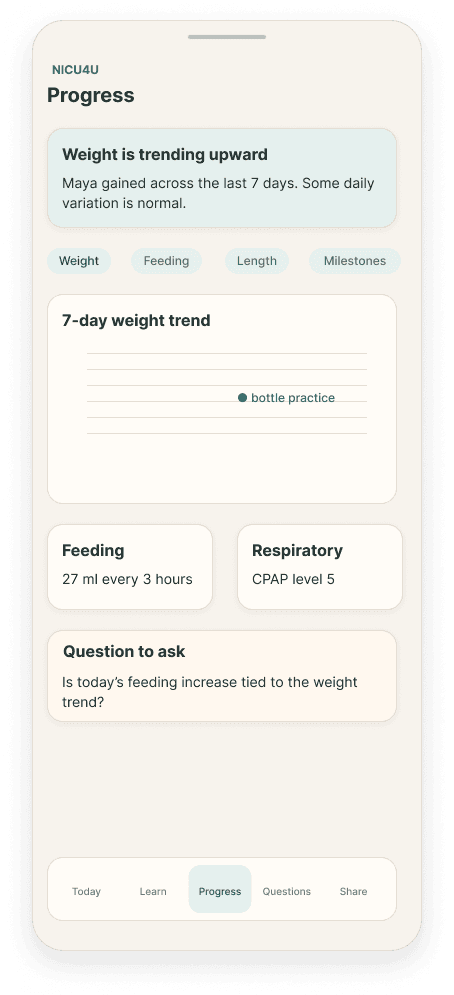
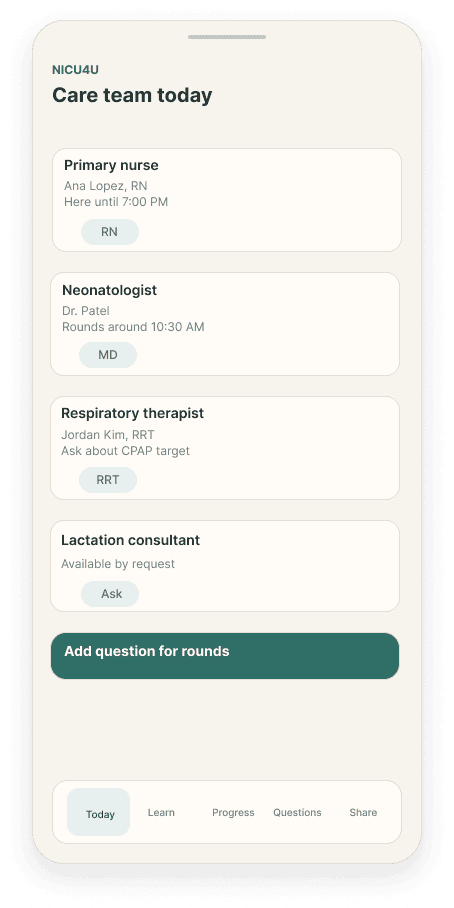
The product response became a calm parent-facing system, not a medical dashboard.
These screens translate the journey-map findings into parent orientation: what changed, what matters now, what is coming next, and what should be asked during care conversations.
Plain-language translation
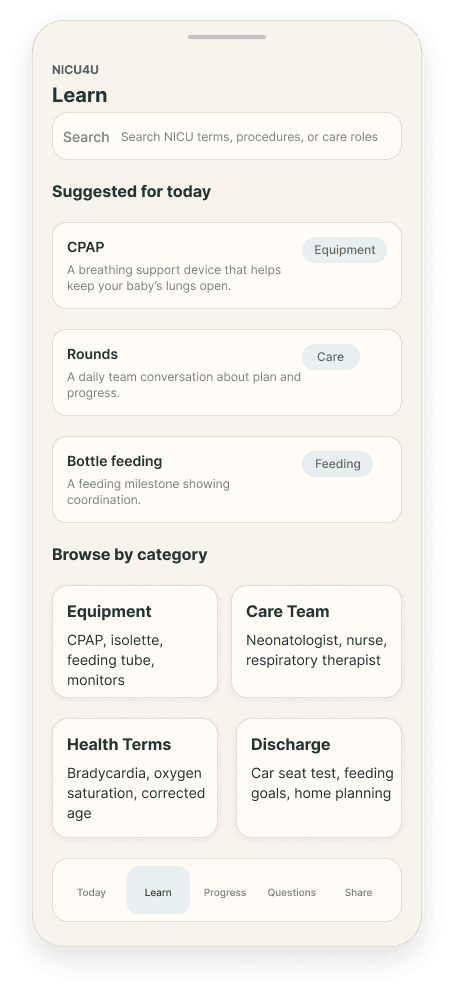
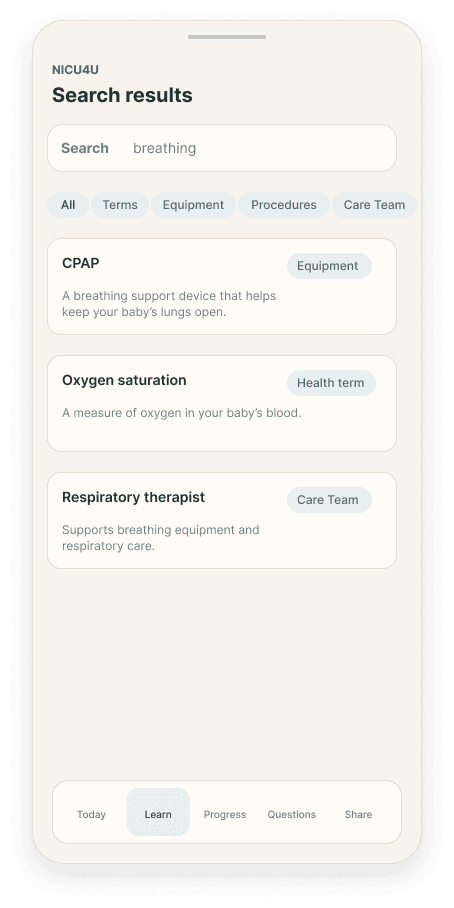
The Learn layer addresses confusion without pretending the NICU is simple.
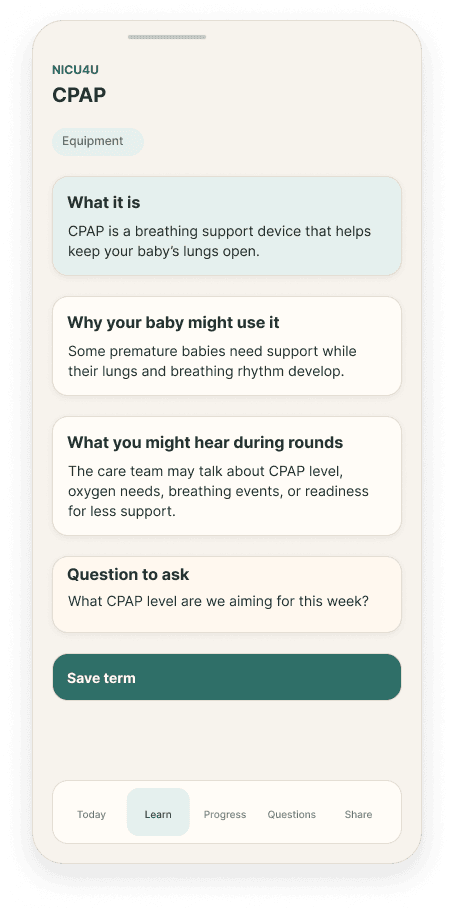
The Learn screens are important because NICU confusion often comes from translating equipment, procedures, roles, and bedside language into something parents can use in the moment. The goal is not to replace clinicians. It is to help parents arrive at rounds with better questions.
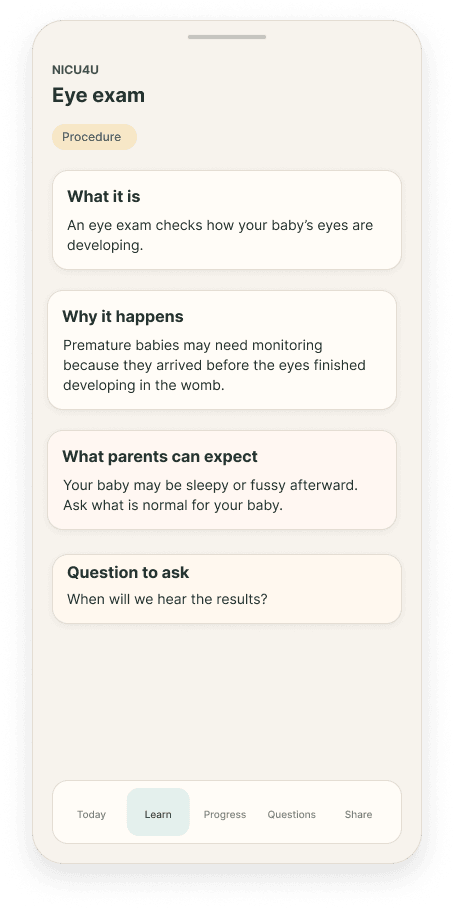
Translation pattern
Explain what it is, why it may matter, what parents might hear during rounds, and one useful question to ask.
Boundary
The app can prepare parents for a conversation. It should not turn educational content into clinical advice.
Question and care-team loop
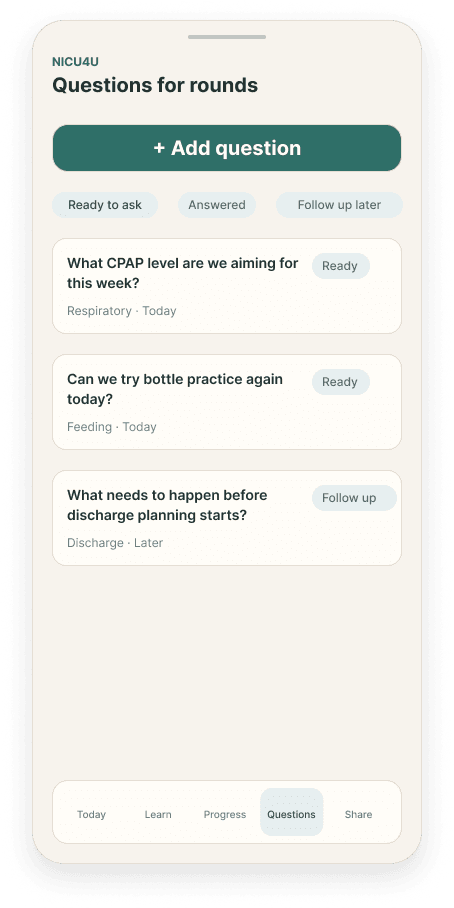
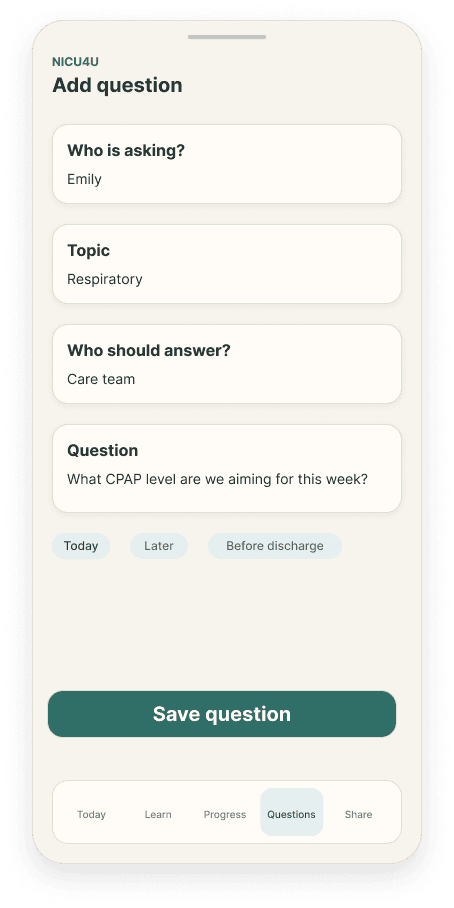
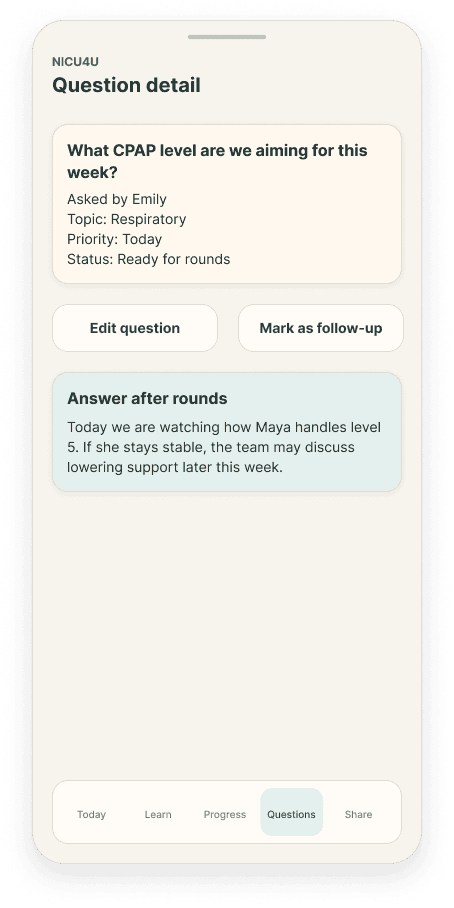
Questions needed to survive the gap between remembering and asking.
This flow turns parent questions into a shared object that can be saved before rounds, assigned to the right care role, answered in plain language, and marked for follow-up instead of disappearing into memory.
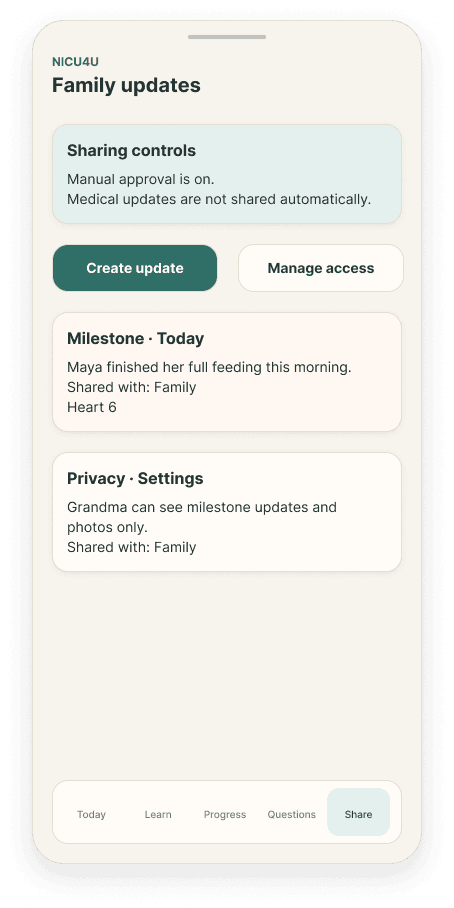
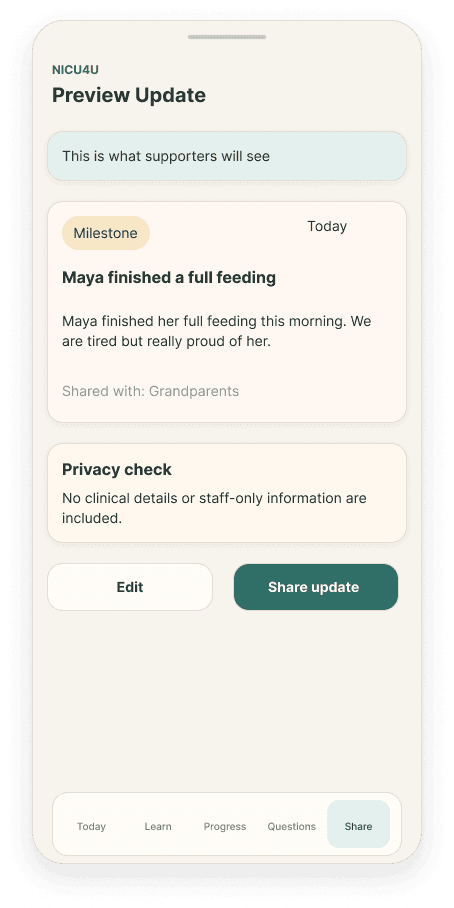
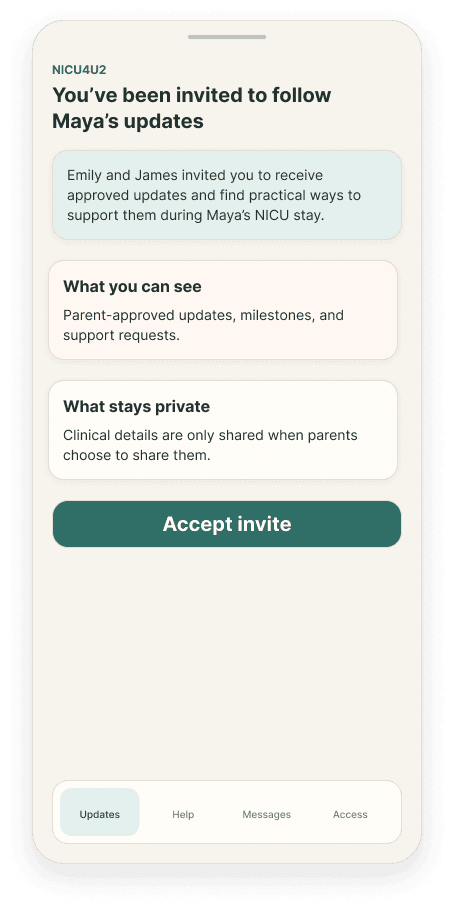
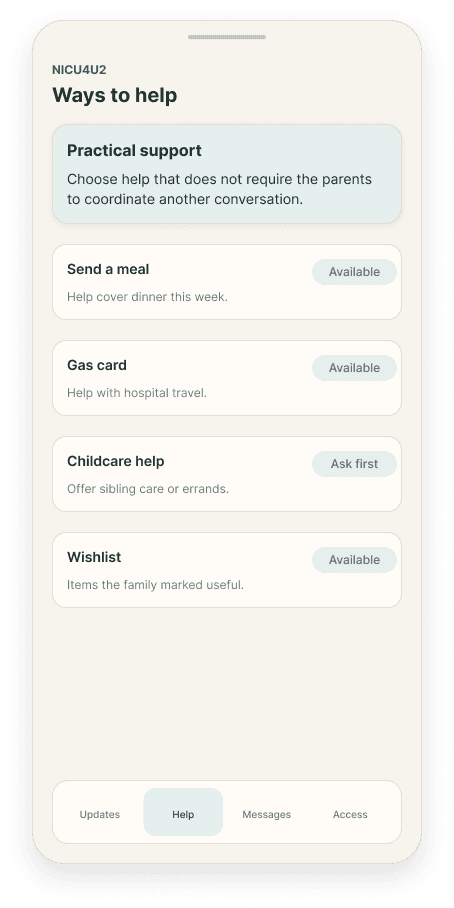
Family support loop
Supporters needed useful access without creating more work for the parents.
NICU4U2 separates approved family updates, practical help, lightweight encouragement, and access control. That matters because family support can become another communication job when parents are already depleted.
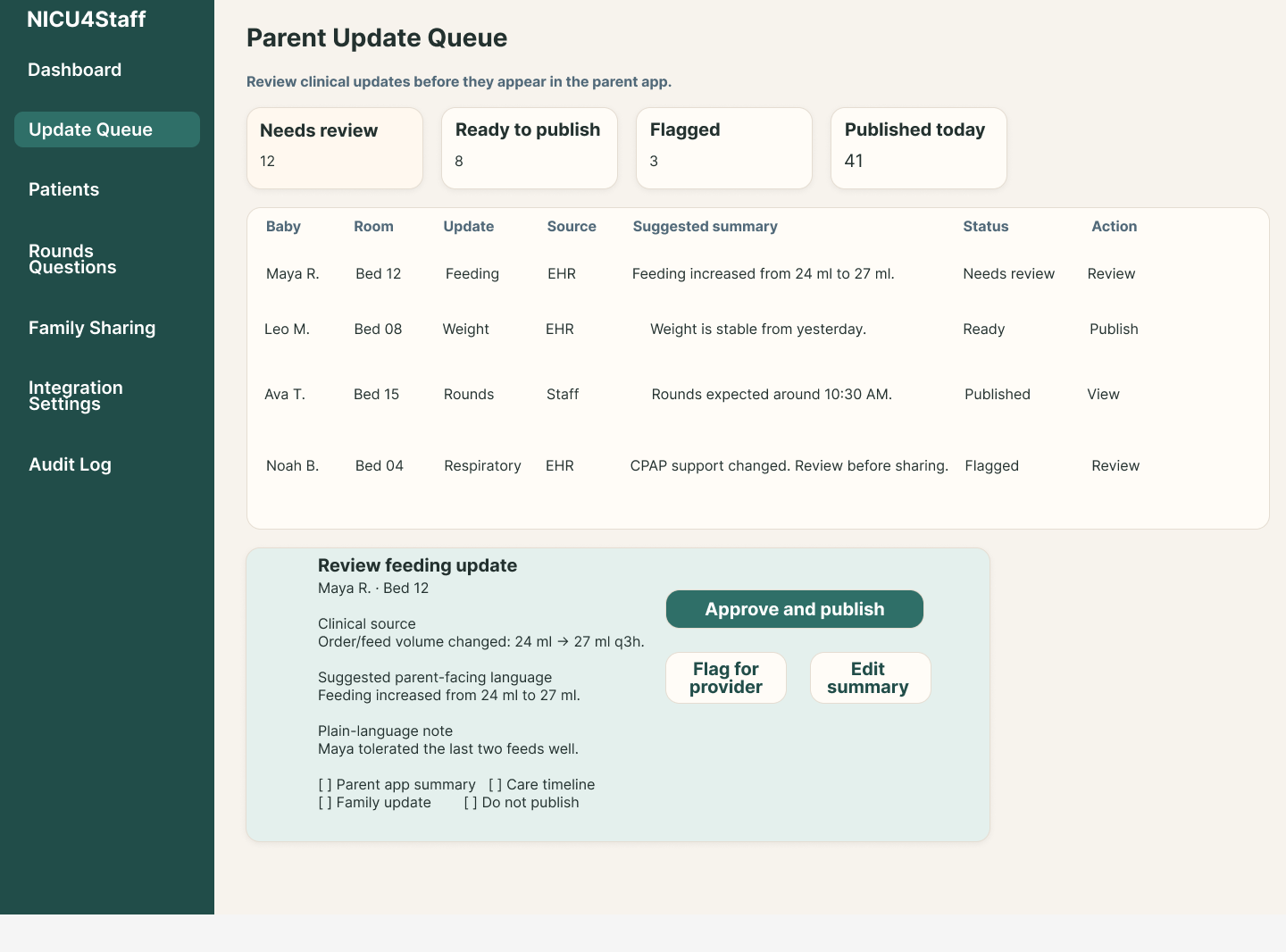
Clinical review boundary
The ecosystem only works if staff review and permission boundaries stay visible.
The staff-facing concept is included as a boundary artifact: parent-facing summaries, shared updates, and round questions need review rules, audit history, and permissions before they can enter a real clinical workflow.
What shaped the system
Information had to move between people, not just screens.
Treat personas as one communication system
Decision: Map the product around handoffs among the primary parent, secondary parent, and nurse.
Tradeoff: The concept becomes less like a simple app screen set and more like a service model that needs clinical review.
Lead with parent questions
Decision: Frame content around what parents are trying to understand or do.
Tradeoff: The system needs careful clinical review before real deployment.
Design walkthrough
How the concept moves from personal tracking to family-care coordination.
Torres family journey
Maps admission, daily care, questions, setbacks, and discharge preparation through actions, thoughts, communication strain, and opportunities.
User problem
Shows where uncertainty accumulates across time instead of treating the NICU as one information screen.
Design response
The journey map shifted the project toward communication breakdowns and repeated explanation burden.
Parent question builder
Organizes questions around what changed, what matters now, who can answer, and what the family needs to ask next.
User problem
Helps parents preserve questions before rounds or bedside updates.
Design response
The flow prioritizes clarity and handoff support over adding more medical content.
Care-team handoff view
Frames repeated questions and unresolved concerns so nurses can see what has already been explained.
User problem
Reduces the loop of Emily asking, James missing context, and Nadia needing to repeat the same explanation.
Design response
The concept became a communication support system rather than a generic parent education app.
Research / testing
Clarify parent needs during uncertain NICU moments and identify where communication strain accumulates.
Persona development, Torres family journey mapping, information hierarchy critique, and support-flow modeling.
Parents do not fail to understand the NICU because they lack intelligence. They fail to keep up because critical information is fragmented across people, shifts, and moments of extreme cognitive load.
Repeated explanations create burden on both sides. Nurses answer the same questions across shifts not because parents are forgetful but because context does not travel with the question.
The anxiety around feeding and supply is not irrational. It is a direct response to feeling responsible for something you cannot fully observe or control. Data reduces that anxiety more reliably than reassurance does.
What parents need most during rounds is not more information - it is a way to hold their questions until they are in front of the right person.
The project frames NICU support as a layered communication system: what changed, what matters now, questions to ask, and who should answer.
Outcome
A communication-support concept organized around understandable updates, next-step clarity, repeated-question relief, and parent-to-care-team coordination.
The hardest health UX problems are often coordination problems: the right information exists somewhere in the system but does not reach the person who needs it in an actionable form.
Reflection
What this project sharpened.
The hardest health UX problems are often coordination problems: the right information exists somewhere in the system but does not reach the person who needs it in an actionable form.
The project uses longitudinal records and service modeling to turn that coordination burden into explicit design requirements.
The strongest next version of NICU4U requires clinical stakeholder review, nurse workflow research, and parent feedback sessions with families currently in care. The concept is credible when it stays focused on communication strain and does not imply it can reduce medical uncertainty itself.
Managing information is not the same as managing clinical outcomes. That boundary needs to remain visible in every future iteration.