Transfer-aware prompts for returning Assassin's Creed players.
Back to work
Transfer-aware onboarding concept
AC Origins Onboarding Redesign
Behavior-informed onboarding research using input logs, overlays, and negative-transfer evidence.
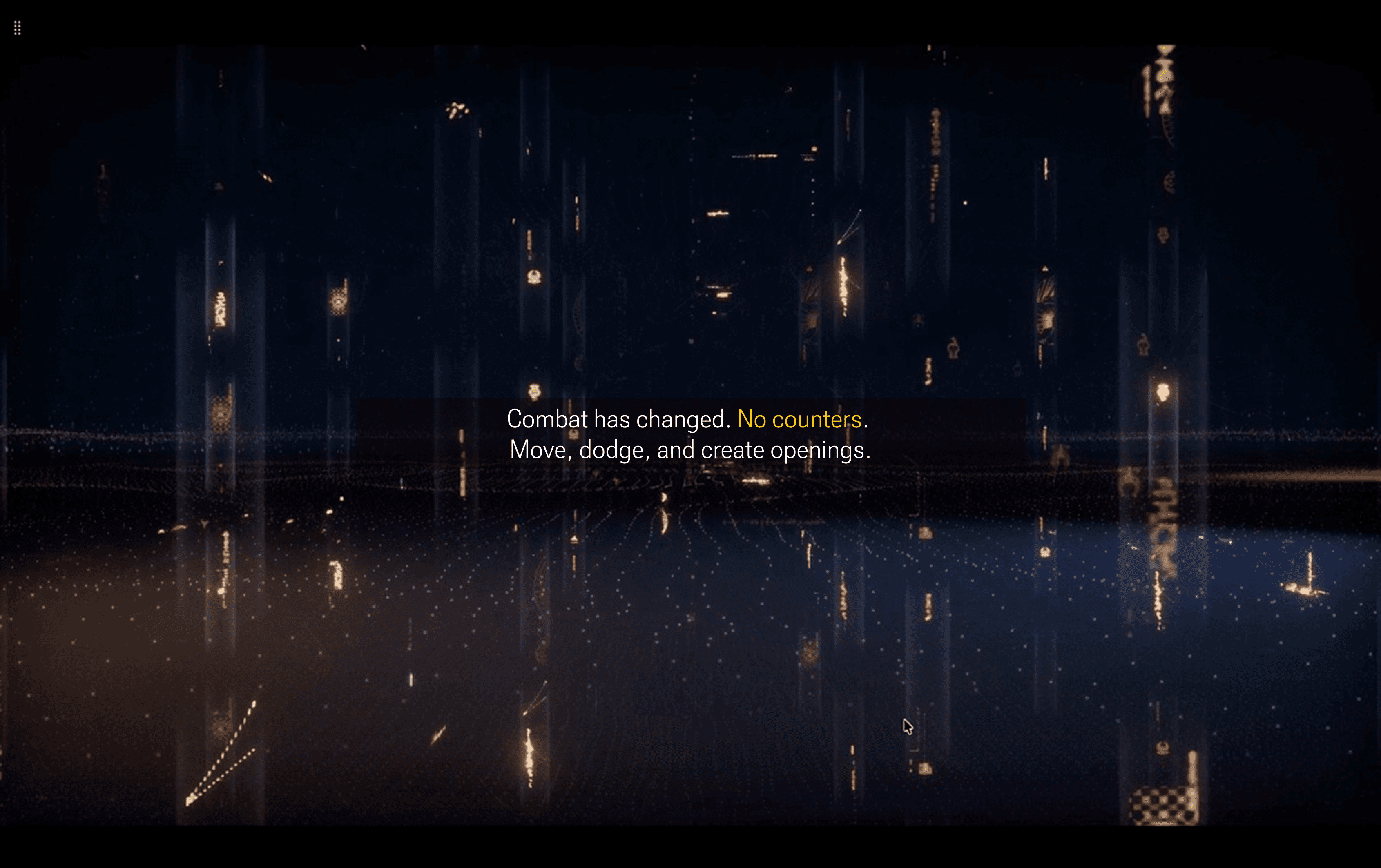
At a glance
The redesign treats onboarding friction as negative transfer: returning players bring old control habits into a changed combat system.
Expert review, controller logging, overlay testing, and synthesis.
Intervention sessions showed fewer repeated legacy inputs.
Clearer model-shift teaching, with cohort-balance limitations noted.
Study overlays, gameplay analysis, and comparative analysis.
Problem
Players coming from older Assassin's Creed titles can carry control expectations into Origins, creating early combat friction and misreads.
Why this matters
- Returning players do not arrive neutral; they bring learned control patterns.
- Early combat friction can feel like player failure when it is actually schema conflict.
- Onboarding has to teach the new model while acknowledging old habits.
Design challengeHow might onboarding reduce negative transfer when a franchise changes its core control model?
Research framing
The question was how legacy players adapt when a franchise changes its interaction grammar.
The study focused on negative transfer: returning players bring useful expertise, but that expertise can become friction when the combat model changes from counter-chain habits to Origins' RB/RT-centered combat.
Research questions
Expert review
Brotherhood primer
Origins onboarding
Arena combat
Logs + survey
Expert review to design response
The critique pointed to transitional signaling, not more generic tutorial text.
Remapped combat controls
Prompt returning players before old face-button habits become repeated arena errors.
No transition signal
Frame Origins as a combat model shift, not just a new button layout.
Spatial hitbox combat
Teach movement, positioning, and attack timing before full pressure.
Novice-only onboarding
Acknowledge legacy knowledge and redirect it instead of ignoring it.
Qualitative synthesis
The persona came from recurring themes, not a standalone storytelling artifact.
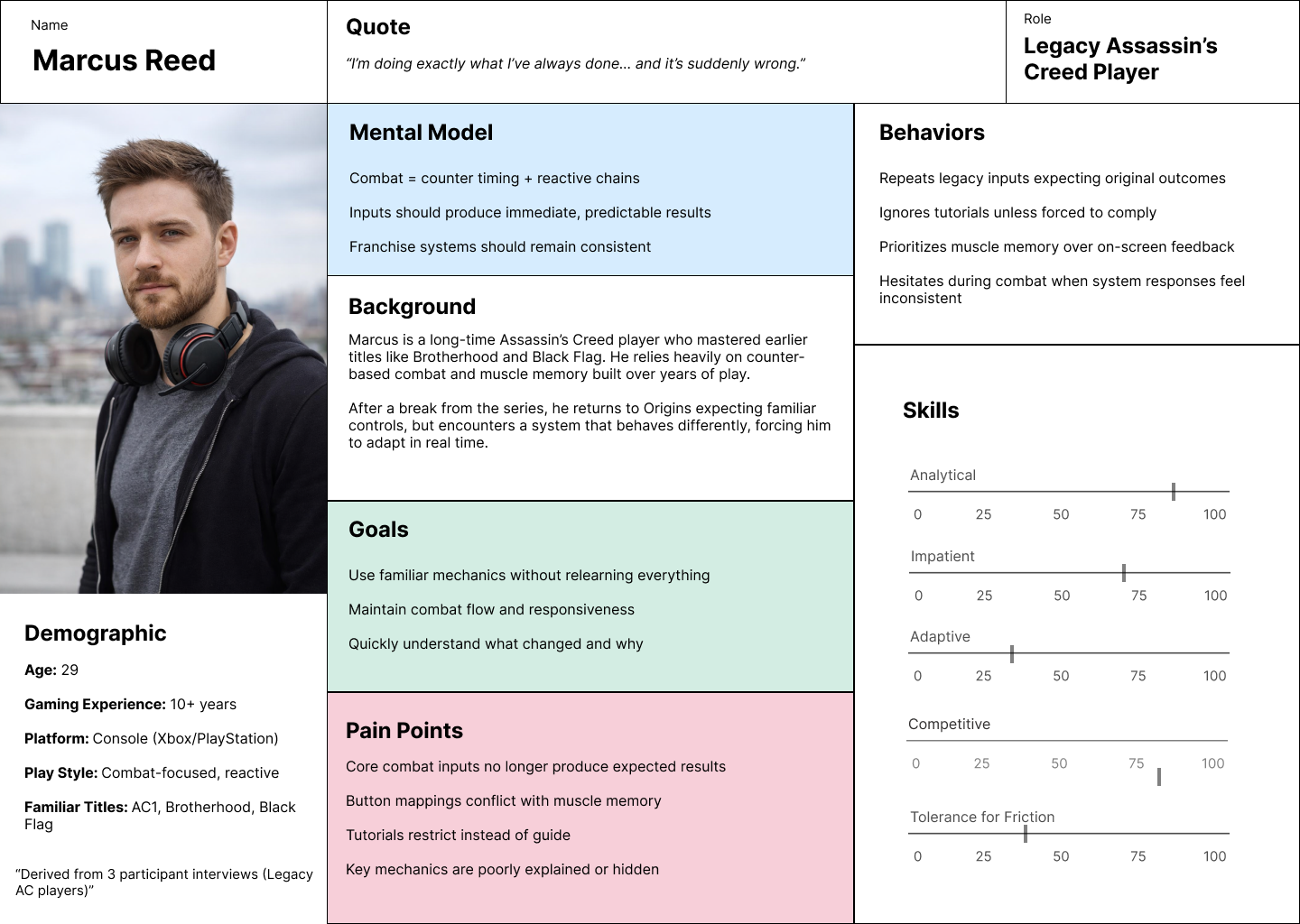
"I'm doing exactly what I've always done... and it's suddenly wrong."
Players expected older counter-chain combat and interpreted Origins through that schema.
Participants described reaching for familiar buttons even when the mapping had changed.
Restricted onboarding reduced experimentation while players were trying to rebuild habits.
Players were learning controls, visual signals, and combat timing at the same time.
System model
How the system moves
01
Diagnose
Identify legacy-player friction through research questions, expert review, and thematic analysis.
02
Instrument
Capture Brotherhood primer, Origins onboarding, arena combat, overlay events, and controller logs.
03
Intervene
Use prompt timing to explain the model shift when repeated legacy inputs appear.
04
Evaluate
Compare participant-level behavior, repeated-X detections, correction outcomes, and survey responses.
Design evolution
Observed legacy habits informed a context-aware onboarding intervention.
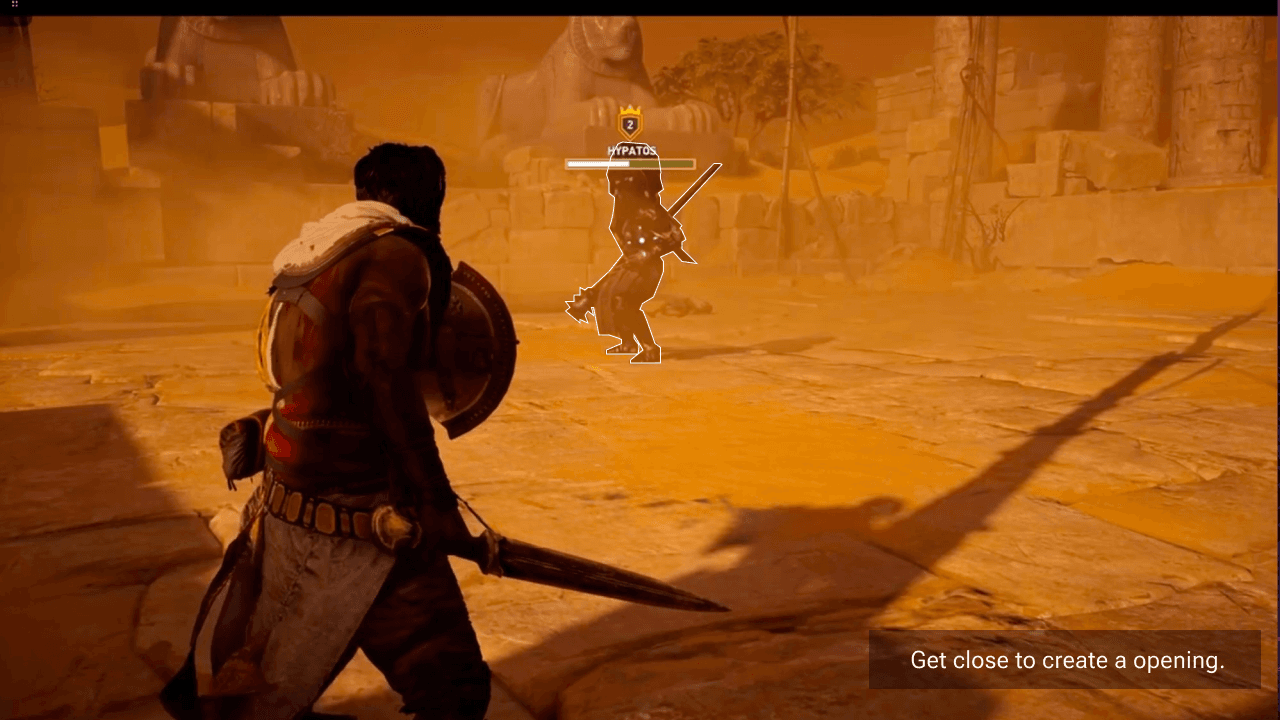
Legacy combat expectation
The baseline showed the unassisted moment where returning players brought an old combat schema into Origins.
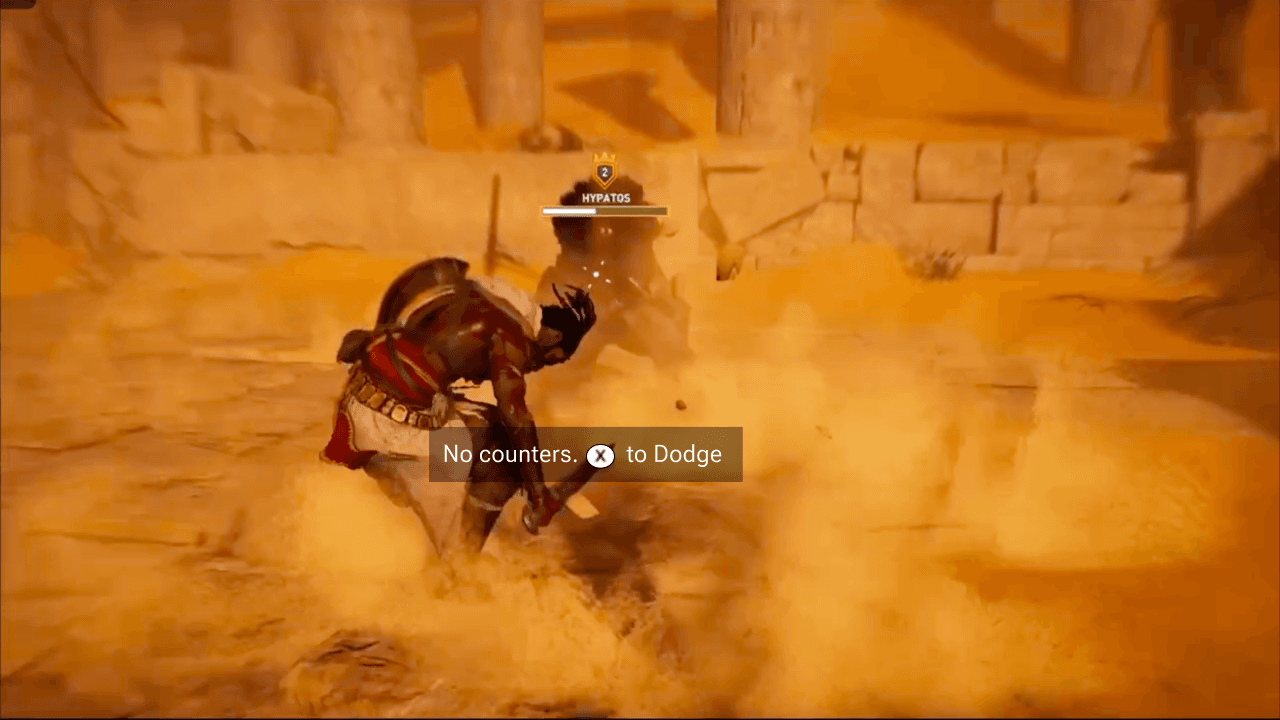
Signal the model shift
The overlay explains the change before repeated habits are interpreted as player failure.
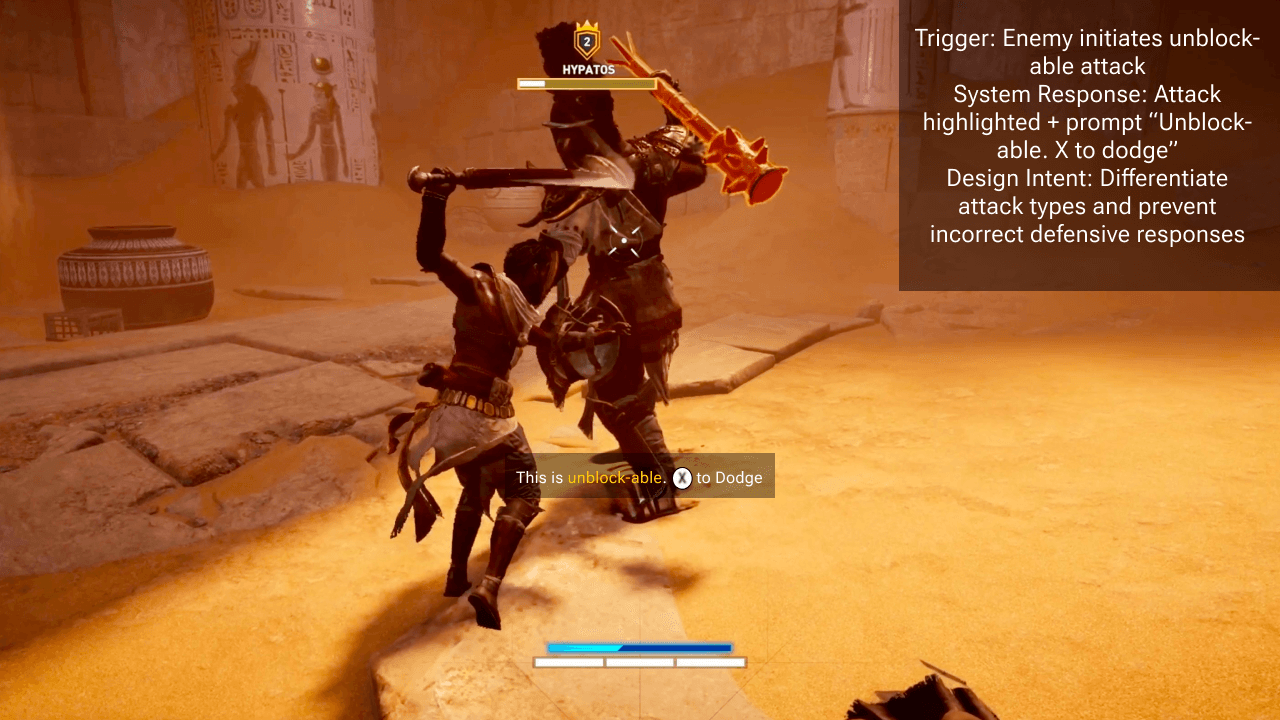
Prompt under pressure
A behavior-triggered cue moves the player from explanation into the actual combat moment.
Process artifacts
The intervention targets the moment old habits fail.
I approached the onboarding issue as a negative-transfer problem. The study connected research questions, expert review, thematic themes, controller logs, and overlay-trigger evidence to understand whether returning players were trying to solve Origins with an older control schema.
Legacy control schemaRepeated input habitOrigins combat grammar
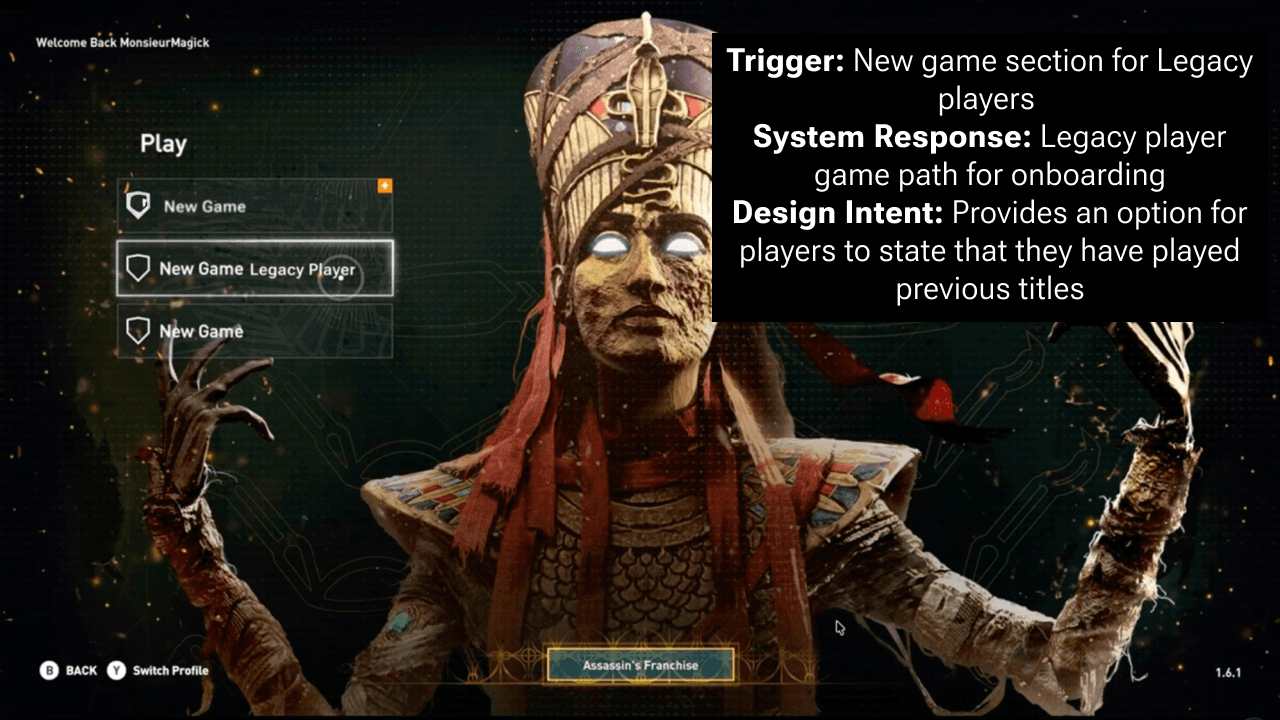
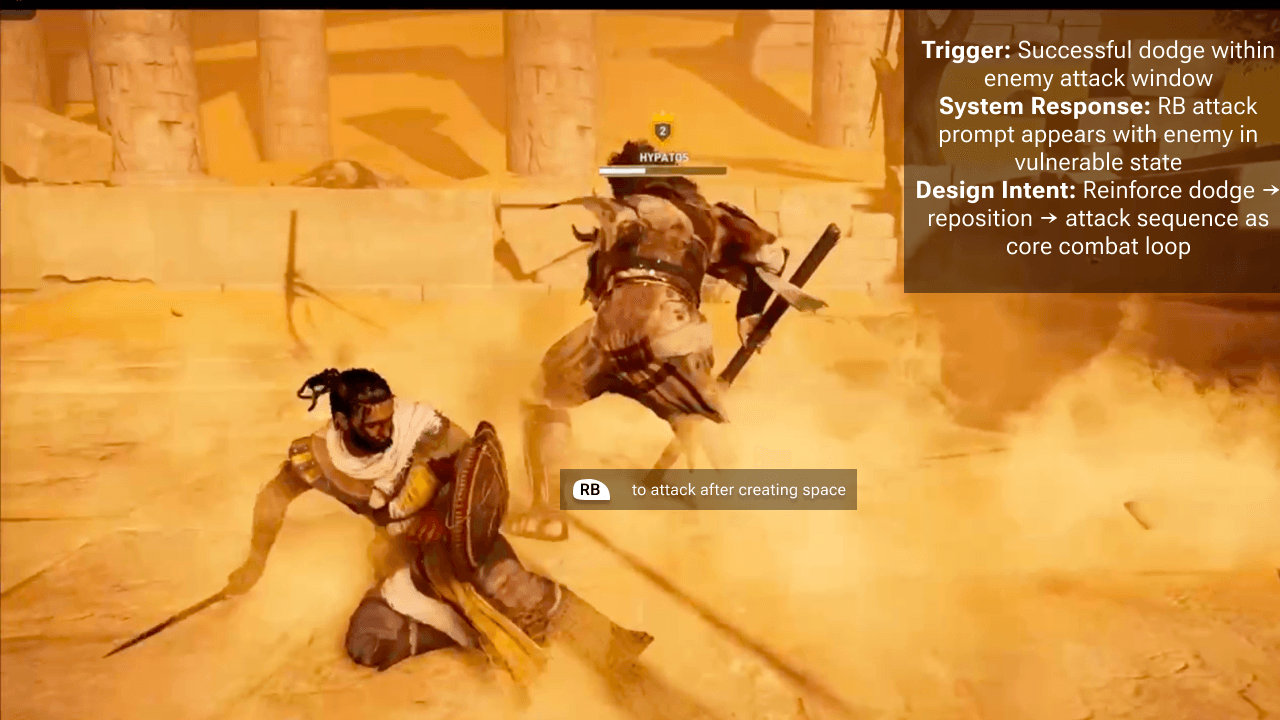
01Notice mismatch
02Practice new model
03Transfer into combat
Intervention artifacts
The overlays teach the model shift at the moment the old habit becomes visible.
The intervention did not just label controls. It detected repeated X behavior, prompted for the replacement attack input, then checked whether the participant corrected behavior afterward.

Tell returning players the combat grammar changed before the first major fight.
Point attention toward RB/RT attacks instead of older face-button expectations.
Use behavior-triggered guidance when repeated X inputs appear.
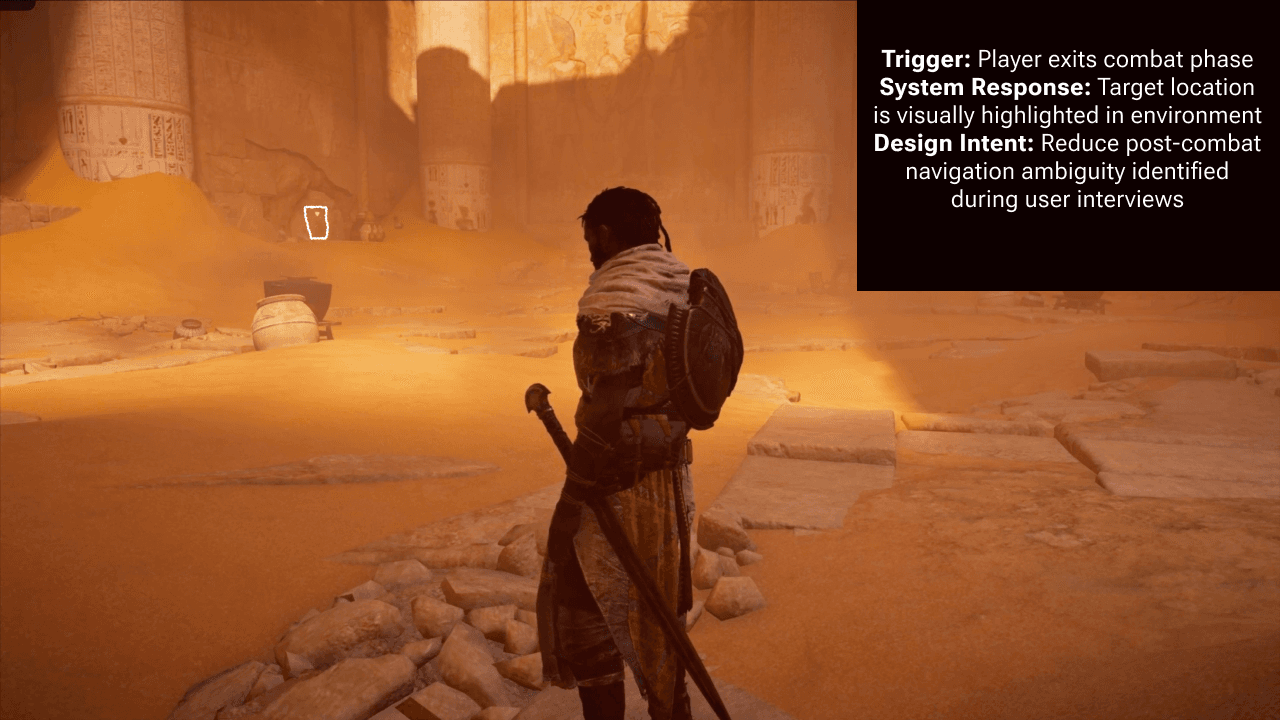
Move from instruction into live combat where the new model has to hold.
Behavior logs
The strongest evidence is the prompt-response chain captured during onboarding.
Both adaptive prompts were followed by corrected or corrected-after-repeat behavior.
One event did not correct immediately, but later prompt events showed replacement input use.
Control participants had onboarding logs but did not receive the behavior-triggered prompt layer.
01Repeated X detected
02Adaptive use-RB prompt
03Replacement input observed
04Arena transfer measured
Directional findings
The input logs supported the negative-transfer framing, with important limits.
This was a four-participant directional study. The condition groups were not balanced: both intervention participants were new or low-experience AC players, while both control participants were legacy players.
Brotherhood102.352 X/min
X-heavy legacy pattern.
Origins default44.225 RB/min
RB/RT-centered combat grammar.
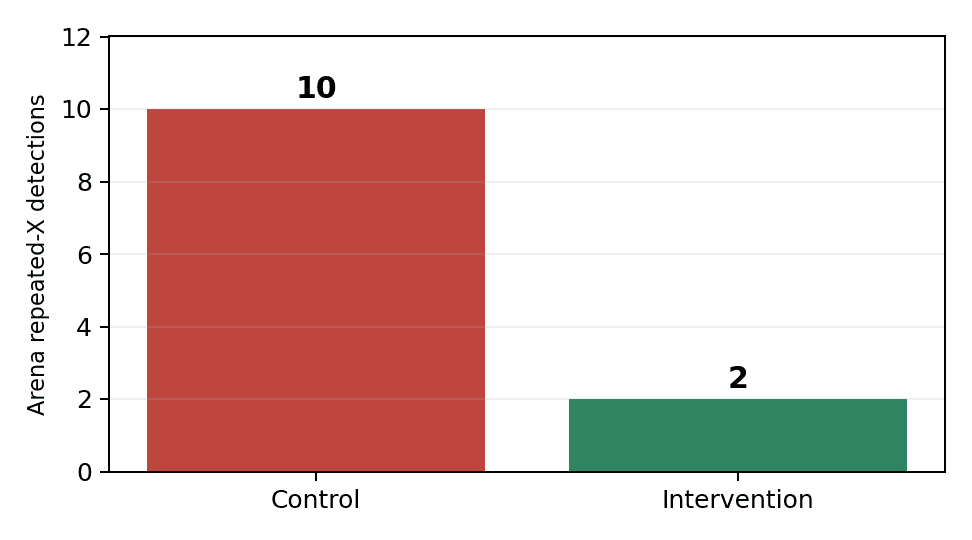
Control arena10 repeated-X detections
No onboarding intervention prompts.
Intervention arena2 repeated-X detections
Five onboarding repeated-X prompts.
ParticipantConditionPrimer X/minArena X/minArena repeated-XInterpretation
P01Intervention35.2120.00002 prompts; corrected after prompt
P02Control82.74718.29010Highest residual X use
P03Intervention53.0984.53523 prompts; mixed correction
P04Control10.8034.8860Low primer X rate; lapsed legacy pattern
Survey responses also showed why the next iteration needs longer low-pressure practice: participants asked for more prompt support, more time to experiment safely, and clearer explanation of trigger behavior.
What shaped the system
Onboarding had to account for what players already knew.
Teach the model shift explicitly
Decision: Frame onboarding around the changed combat grammar, not isolated button prompts.
Tradeoff: More direct instruction, but less avoidable early confusion.
Use overlays at the moment of mismatch
Decision: Place intervention overlays near the first combat transition and trigger adaptive prompts when repeated X inputs appear.
Tradeoff: The overlay must stay lightweight so it does not interrupt combat flow.
Design walkthrough
How the intervention helps returning players rebuild the combat model.
Legacy expectation check
Identifies the older control pattern a returning player may bring into Origins.
User problem
Makes the onboarding problem about habit interference rather than generic confusion.
Design response
The redesign begins by acknowledging prior learning instead of treating the player as new.
Combat transition overlay
Places guidance at the point where older input habits collide with the Origins control model.
User problem
Targets the moment where onboarding should intervene.
Design response
The redesign focuses on negative transfer rather than generic tutorial polish.
Practice before pressure
Adds a short, low-pressure repetition beat before full combat demand rises.
User problem
Gives the player a chance to rebuild the control schema before failure feels like lack of skill.
Design response
The intervention became a sequence: notice the mismatch, practice the new grammar, then transfer into combat.
AI's role
I used the agent to compare research evidence across sources before framing the finding.
Controller logs, overlay events, survey results, expert review, qualitative themes, and participant summaries.
Look across the evidence trail for patterns, contradictions, and places where the data needed a tighter limitation.
Kept the finding directional by identifying participant-level confounds instead of treating the intervention as causal proof.
Research / testing
Understand how previous Assassin's Creed control schemas affect Origins onboarding and what support helps players adapt to the new combat model.
Research-question framing, expert review, thematic analysis, comparative input logging, study overlays, controller-pattern review, and post-session survey analysis.
The expert review identified missing transitional signaling, novice-only onboarding assumptions, and unclear explanation of the combat paradigm shift.
Thematic analysis pointed to mental-model carryover, muscle-memory conflict, tutorial restriction, and cognitive load during onboarding.
Intervention participants generated fewer arena repeated-X detections than control participants, but the groups were not balanced by player experience.
Survey responses suggested players wanted longer safe practice and clearer prompt support.
The redesign teaches the control-model change earlier, ties prompts to mismatch moments, and defines a stronger next study with balanced legacy-player cohorts.
Outcome
A redesigned onboarding direction grounded in expert review, thematic analysis, controller logs, and prompt-response evidence.
The project is strongest when framed as transfer-aware onboarding.
Reflection
What this project sharpened.
The project is strongest when framed as transfer-aware onboarding.
The next step would be testing revised tutorial beats against returning players.
The broader UX lesson is that prior knowledge can be a liability when a product changes interaction grammar.